
VOC Travels to D.C. to Advocate for Non-Opioid Prescriptions for Veterans

Picture of Laura Heltz, Executive Director & U.S. Army Veteran

Laura Heltz, Executive Director & U.S. Army Veteran

For more than a decade, I’ve been working with veterans who struggle with substance abuse. I’ve seen veterans at every stage of recovery – some of whom were able to overcome their addiction; others who relapsed; and, tragically, some who overdosed. In too many of these cases, this all could have been avoided if not for their reliance on prescription opioids. These brave servicemembers stood up for our country and freedoms only to be knocked down by addiction to medication that is supposed to help them manage chronic and post-surgical pain. This is an epidemic that is unfair to the people who served our country.  

Veterans and Opioid Use by the Numbers

I’ve been doing advocacy for with a fantastic organization called “Voices for Non-Opioid Choices.” They are a “nonpartisan coalition dedicated to preventing opioid addiction before it starts by increasing patient and provider access to non-opioid therapies and approaches to manage acute pain.” They report that: 

  •  Nearly half of combat-wounded veterans report misuse of prescription opioids. 

  • Drug overdose mortality rates among veterans increased by 53% from 2010 – 2019. 

  • The healthcare costs of prescription painkiller abuse among service members is roughly $1 billion a year

They go on to say that “Acute pain patients often receive powerful, addictive medications to manage their pain. The surgical setting, in particular, has become a potential path to long-term opioid abuse in America.” 

In July 2022, the Substance Abuse and Mental Health Services Administration (SAMHSA) released its 2020 National Survey on Drug Use and Health: Veteran Adults. This report found that in 2020:  

  • 490,000 veterans aged 18+ reported prescription opioid misuse. 

  • 53,000 veterans aged 18+ reported prescription opioid misuse and heroin use (heroine is a chemically similar drug to opioids, and prescription opioid use can be a steppingstone to other drugs). 

  • Misue of prescription pain relievers is much more common than heroin use. 

 And these are just the veterans who chose to report the misuse. The number of veterans misusing prescription opioids and those using both the prescription and heroin/other drugs is undoubtedly higher than this. 

 How We’re Advocating for Veterans 

On April 17th, Veterans Outreach Center and 79 other organizations signed a letter written by Voices for Non-Opioid Choices to the U.S. Department of Veterans Affairs urging them to update their coverage policy to include non-opioids in their formulary. The formulary is a list of medications and related information that guides prescribing practices, based on the judgment of healthcare professionals. You can read the full letter here, but this paragraph is of particular importance: 

“Unfortunately, the VA National Formulary (“VANF”) does not include several FDA-approved, safe, and effective non-opioid analgesic products, meaning VA patients have little choice in managing their acute pain symptoms. As a result, the policy embraced by the VANF unnecessarily exposes our nation’s veterans to opioid-based analgesic products. This decision is putting their lives in jeopardy.” 

Our veterans need to be set up for success after their military service, and that includes access to non-addictive, non-opioid prescriptions. 


I’ve also spent time on Capitol Hill in Washington, D.C., meeting with House and Senate

 members/staffers to advocate for H.R.10396 – NOPAIN for Veterans Act. Introduced into the house on December 12th, 2024, this bill does exactly what the letter we signed asked the VA to do: “To amend title 38, United States Code, to ensure that the Secretary of Veterans Affairs furnishes certain non-opioid pain medications to veterans, and for other purposes.” 

As I said at the beginning – I’ve been working with veterans who have been dealing with

 substance abuse for more than a decade. It feels good to start looking at ways to get upstream of this problem instead of always reacting to it after the fact. The absolute s

urest way to reduce opioid addiction is to ELIMINATE exposure in the first place. And that starts in the healthcare setting.

Reinterpreting Veteran Needs for the Future of Services

Picture of Laura Heltz, Executive Director & U.S. Army Veteran

Laura Heltz, Executive Director & U.S. Army Veteran

The understood contract between our country and its veterans has historically centered on tangible forms of compensation and care, such as access to medical services, benefits, shelter, and assistance in finding secure and meaningful civilian employment. These obligations are, without question, foundational pillars of our societal responsibility for those who wore our nation’s uniform. Yet, as we continue to assess the veteran support landscape, a more encompassing understanding of “need” requires our consideration. Veterans Outreach Center (VOC) has witnessed the evolving lives of veterans since its inception in 1973, and in the same way our founders felt, we are compelled to continually reevaluate the traditional models of veteran services to keep up with their changing needs and preferences.   

Well-Being, Connection, and Purpose

The evolution of veteran services emphasizes the transition from solely receiving foundational benefits to striking a balance between transactional benefits and holistic well-being. This evolving transition prioritizes:  

  • Comprehensive well-being that extends beyond baseline “fixes” of specific ailments to encompass the overall physical, mental, and emotional flourishing. It implies an approach that empowers veterans to be active agents in their journey toward sustained health.  

  • While economic stability is a primary need, many veterans seek to apply their unique skills and military experiences to a job or career that provides them with inherent meaning – a demonstrable contribution to society and their community.  

Related Post: Why Economic Stability is a Critical Issue for Female Veterans

  • True reintegration extends beyond the basic utilization of services, instead signifying paths for veterans to navigate and find meaningful participation in the broader community. 

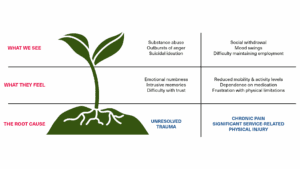
Instead of merely treating symptoms, we must diagnose and resolve the root causes of veteran challenges. A food pantry might address hunger, but the underlying issue could be unemployment. If job assistance isn’t enough, the ultimate root might be a lack of community and connection, which can be found at peer support groups. We understand this at VOC and structure our services in a way that allows us to treat the symptoms while working toward the identification and resolution of the root causes.

Becoming a Center of Holistic Support  

At VOC, we’re proud to embrace a comprehensive understanding of veteran services. We don’t purely serve as a conduit or middleman for foundational services; instead, we strive to go beyond that and provide individualized, holistic support that serves the entire veteran as a human.  

Healing Through Hydromassage  

In addition to offering established wellness initiatives like art therapy, outdoor recreation groups, and mindfulness practices, we recognize the need to support veterans navigating other service-related health challenges. Hydromassage is an effective method for pain management in a safe and supportive environment.  

For instance, veterans exposed to Agent Orange often face conditions like peripheral neuropathy. This causes numbness, tingling, or prickling in the toes or fingers in the early stages that can spread to the feet or hands. In later stages, it can cause burning, throbbing, or shooting pain that is worse at night. Hydromassage, as a therapeutic modality, demonstrates potential for alleviating neuropathic symptoms through improved circulation and pain reduction.  

The U.S. Department of Veterans Affairs (VA) states that one in three female veterans reports that they experienced sexual harassment or assault while in the military. For these veterans battling the intertwined burdens of military sexual trauma (MST) and chronic pain, traditional, hands-on therapies can be problematic. The experience of MST violates personal boundaries and can lead to touch aversion, hypervigilance, and the potential for physical touch to trigger distressing memories or physiological stress responses. Hydromassage is a beneficial alternative, delivering the therapeutic effects of massage, such as pain alleviation, stress reduction, and improved circulation, without direct physical contact. This creates a crucial sense of safety, control, and alignment with trauma-informed care principles.  

The Power of Peer Support  

We actively cultivate opportunities for communal engagement, from peer support programs to shared activity groups, all hosted within a welcoming environment designed to help veterans feel safe, understood, and supported. The effectiveness of peer support for veterans is particularly notable, stemming from the connection forged through shared lived experiences, especially military service and often personal recovery journeys. This common ground grows empathy, reduces the stigma often associated with seeking help, and builds upon the inherent trust and camaraderie of military culture. This deeply relational support translates into significant positive outcomes, including reductions in PTSD symptoms, depression, and anxiety, alongside increased empowerment and self-efficacy.  

Our Steve Preston Peer Connection Center (PCC) gives veterans a space to come together and connect. Groups such as the Men’s Recovery Group, Cultivating Resilience, and Open Art Studio are led by a licensed clinician or certified peer specialist, serving as vital bridges that guide fellow veterans through complex systems and encourage sustained engagement with care and support. These programs enhance social integration and combat feelings of isolation.  

A study from the VA revealed a significant correlation between the frequency of engagement with peer specialists and positive changes in psychiatric symptoms. Veterans who had over twelve contacts with a peer specialist (“high engagers”) were substantially more likely to experience reliable positive symptom changes (over 40%) compared to those with fewer than twelve contacts (“low engagers,” 24%) and a control group (11%). While no significant differences in hope were observed between groups, these results strongly suggest that more frequent, sustained interactions with peer specialists yield greater mental health benefits. 

Fitness for Physical and Mental Resilience  

Regular exercise offers physical benefits, which are crucial for addressing the high incidence of musculoskeletal injuries among veterans, improving cardiovascular health, and aiding in weight management. For those with service-related injuries, adaptive exercise ensures these benefits remain accessible.  

The mental health advantages of exercise are equally compelling. Physical activity elevates mood and alleviates symptoms of PTSD, depression, and anxiety. It also enhances sleep quality, improves cognitive functions like memory and concentration, which are often impaired by trauma, and provides a valuable sense of routine, purpose, and empowerment. For many veterans transitioning to civilian life, the discipline and accomplishment derived from a fitness regimen, coupled with the potential for social interaction in group settings, are invaluable tools for resilience and adaptation.  

At the height of the COVID-19 pandemic, a time of significant stress and isolation, we safely opened our on-site fitness center, giving veterans a vital and safe space to continue working on both their physical and mental health.   

Related Post: Tips for Veterans to Build and Maintain an Exercise Routine for Lasting Mental Health Benefits  

Strengthening the Whole Veteran  

Providing the fundamental entitlements of veterans remains a critical societal duty. However, a thoughtful consideration of the path forward, particularly within communities like ours in Rochester, New York, mandates an expansion of society’s vision of veteran services. To honor service is to facilitate stability and conditions for flourishing. By nurturing and strengthening the complete well-being of our veterans, we simultaneously enrich the vitality and strength of our community.

The Long-Term Effects of Low-Level Blasts: New Legislation Offers Hope for Disability Benefits

Picture of Laura Heltz, Executive Director & U.S. Army Veteran

Laura Heltz, Executive Director & U.S. Army Veteran

Many veterans experience repeated exposure to low-level blasts during their military service, both in and out of combat. These exposures can cause subtle damage to the brain and body that may not be immediately apparent. The effects of the damage can manifest years later.

Over time, this damage can show up in a variety of ways, impacting veterans’ physical health, mental well-being, and overall quality of life.

  • Physical Health: Veterans may experience neurological issues such as headaches, dizziness, memory problems, and difficulty concentrating. They may also develop sleep disorders, tinnitus (ringing in the ears), and balance problems. In some cases, blast exposure has been linked to more serious conditions like Parkinson’s disease and chronic traumatic encephalopathy (CTE).

  • Mental Health: The invisible wounds of blast exposure can also take a toll on veterans’ mental health. They may experience increased rates of depression, anxiety, post-traumatic stress disorder (PTSD), and even suicidal ideation. These mental health challenges can strain relationships, disrupt careers, and lead to social isolation.

  • Quality of Life: The cumulative effects of these physical and mental health issues can significantly diminish a veteran’s quality of life. They may struggle with daily tasks, experience chronic pain, and face difficulties in their personal and professional lives. This can lead to financial strain, decreased independence, and a sense of hopelessness.

What’s more, because there are gaps in the medical evidence related to the long-term impacts of these repeated exposures, it makes it harder for veterans to receive the proper care and benefits if they develop blast-related health conditions later in life.

However, legislation is currently being urged forward in Congress that would require a detailed study about the long-term impacts of exposure to repetitive low-level blasts. Assuming the results of the study show a correlation between the repeated blasts and long-term health effects, it could lead to the establishment of new disability compensation benefits eligibility for veterans who were exposed to repetitive low-level blasts while serving in the military. This would be a big step forward in recognizing and addressing the hidden wounds that many veterans carry.

The Need for Action: It’s crucial to recognize and address the unique needs of veterans who have been exposed to low-level blasts. This includes:

  • Increased research: More research is needed to fully understand the long-term effects of blast exposure and develop effective treatments.

  • Improved diagnosis and care: Healthcare providers need to be trained to recognize the subtle signs and symptoms of blast-related injuries.

  • Greater awareness: Raising awareness among veterans, their families, and the public about the potential impact of low-level blasts is essential.

We’re hopeful that this study will proceed and show the needed evidence to get veterans the help and support they’ve earned. As we continue to monitor this legislation, we have a number of free services for veterans and their families that can help them navigate the physical, mental/emotional, and quality of life challenges that can come from military service. Please request services today to get started.